Claude Sonnet 5: Rethinking How You Pick Models for Automation
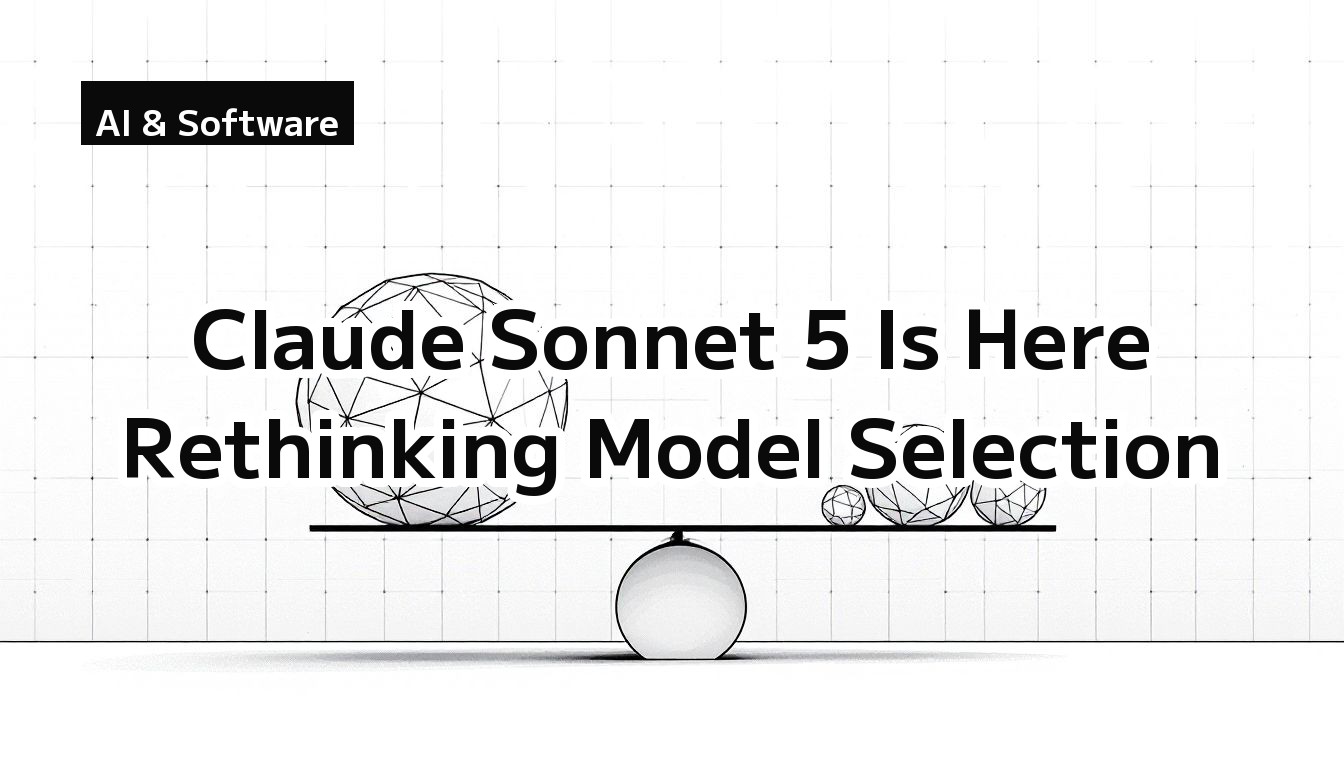
When a model with near-flagship performance arrives at a lower price, should you migrate everything? Here is the axis we use for model selection in our own automation work.
In late June 2026, Anthropic released Claude Sonnet 5. The headline: performance approaching the flagship Opus 4.8, at a lower price. Introductory pricing is $2 / $10 per million input/output tokens through the end of August 2026, then $3 / $15 — versus $5 / $25 for Opus 4.8 (as of late June 2026).
Announcements like this immediately raise a practical question: should everything we currently run on a higher-tier model move to this one? We asked ourselves the same thing, as a team operating many automated workflows daily. This article is less about the benchmark numbers and more about what to re-examine when they change.
Not “which model” but “which model for which task”
A model getting cheaper and stronger is welcome news. But picking “the strongest” or “the cheapest” across the board optimizes neither cost nor quality. What matters in practice is how you assign models to tasks.
We make that assignment based on the cost of failure for each task:
- High-volume work where mistakes are cheap (bulk preprocessing, classification, first-pass summaries) goes to cost-efficient models
- Decisions where mistakes are expensive (final fact checks, pre-publish review, delicate tone work) stay with top-tier models — or with people
Seen through that lens, a model like Sonnet 5 — near-top performance at a lower price — is a candidate to take over the large middle ground where the choice used to be uncomfortable: too costly to send everything to the flagship, too risky to send everything to the cheapest option. That middle is where the most movement happens.
Benchmarks are a starting point; judge on your own workload
Benchmarks are a useful starting point, but they are not your business. A model that closes the gap on public leaderboards may not show the same gap on your specific tasks — your formats, your terminology, long contexts, tool integrations. Our policy is to try a model on our actual workload, in a small way, before switching anything.
Nor do we rely on the model alone for quality. Our content pipeline reviews generated output in two passes — detect and fix, then re-verify — and everything stops as a draft for human review before it ships. As models get cheaper and stronger, this “quality from process” design becomes more valuable, not less: run inexpensive models at volume, and the downstream checks and human gate absorb the variance.
What to check before you migrate
Before shifting work to a new model, here is what we look at.
Price the permanent rate, not the promo
Introductory pricing tends to be time-limited. Estimate your monthly token volume, however roughly, and compute the monthly cost at the permanent rate ($3 / $15 in this case). We treat launch discounts as a discount on validation costs — not as the basis for a migration decision.
Read performance along your own axes
Even when overall scores are close, models differ by axis: coding, long-context reading, tool use, instruction following. If you have already articulated which axes matter for your workload, you will know exactly which numbers in the announcement to read — and decide faster.
Match safety characteristics to the use case
Sonnet 5, for example, is reported to have lower capability on security-related tasks than the Opus tier. Depending on your use case, that can actually be desirable. For agents that act autonomously, the frequency of undesirable behaviors matters as much as raw capability.
Migrate in stages
Do not switch everything at once. Replace low-impact steps first and watch. The more automated your operation is, the more a “stoppable” design and staged rollout pay off. Keep a fast path back to the previous configuration for a while; it caps the damage if quality degrades in ways you did not anticipate.
A lightweight way to test
Trying a model on your own workload does not require an evaluation platform.
- Pick one representative task — high-volume, low failure cost; not a judgment-heavy one
- Assemble a small evaluation set — a few dozen real inputs from past runs, with a short written definition of “what counts as good.” Criteria as rough as “nothing essential missing, tone intact, no factual errors” are enough; comparing by feel drifts when the model changes
- Run old and new side by side — same inputs to both, compare quality, speed, and cost
- Switch with a way back — cut over in a form you can revert instantly, and monitor for a while
Unglamorous steps, but they are the shortest route to the one thing benchmarks cannot tell you: how the model fits your work.
Common misconceptions
“Cheaper model means lower quality” — not necessarily. With verification steps and human review built into the process, the differences between individual models are increasingly absorbable in operation. Conversely, leaning on a flagship model without process design still leaves you with variance.
“Mixing models complicates operations” — it does add moving parts. But if the model-to-task assignment lives in configuration, in one place, the complexity stays contained inside the design. In our own pipeline, swapping a model is an ordinary operational task, not a project.
“A new model means you should migrate” — only half true. Migration itself costs validation and cutover work. The wins are biggest where cost or quality is a clear bottleneck. You do not need to chase everything.
Summary
Not “use the flagship,” not “use the cheapest” — assign each task a model according to its cost of failure. That is the axis we hold in model selection, and a release like Sonnet 5, with near-top performance at a lower price, is a good trigger to revisit the assignment.
The point is not to swap everything each time a new model ships. It is to keep a discipline of updating the assignment as your workload evolves — deciding what to delegate and where people stay in the loop. Models will keep getting faster and cheaper. Setting a rhythm for these reviews — on major releases, or quarterly — keeps the process routine instead of reactive. That design, more than any single model choice, is what makes automation resilient to change.
Prices and performance figures are as of late June 2026 and may change. Please confirm against official sources before adopting.